Home / FAQ
Questions
The questions we get,
answered without a sales layer
Everything below is what we would tell you on a call. Where the honest answer is that we might not suit you, that is what it says, because finding out three weeks in helps nobody.
Grouped by what you are trying to work outNo pricing games
Questions
Grouped by what you are trying to decide
Six groups, from what the product is through to how it is priced.
FAQ • Walkthrough
Grouped by what you are trying to decide
Six groups, from what the product is through to how it is priced.
- What it is
- How it works
- Using it day to day
SIX GROUPSPICK WHERE YOU ARE
01What it isFirst look
02How it worksUnderstanding
03Using it day to dayRunning it
04Fit and sectorChecking fit
05Setup and dataGetting started
06PricingDeciding
IN WHAT IT IS
What does it actually replace?
01
What it is
The basics, answered plainly
What is ProcureAudit?
A dedicated workspace for government contract purchasing files. It holds awards and their modifications, the checklists each award has to pass, a document drive and an activity record, so the reasoning behind a purchase is captured while the work happens rather than assembled afterwards.
How is it different from the main eProcureAI platform?
The main platform runs day to day buying, requisitions and supplier management. ProcureAudit covers the purchasing record behind contract awards. Many contractors run both, and some run ProcureAudit on its own alongside whatever they already use for buying.
Is this a document storage tool?
No. Storage holds files. This holds awards, the phases each one passes through, the reasoning behind decisions and who approved what, with documents attached to the phase they support rather than sitting in folders.
Do you make judgements about our purchasing?
No, and we would be cautious of anything claiming to. The workspace applies the rules you set and records what happened. Deciding whether a supplier is acceptable or a purchase is justified stays entirely with you.
02
How it works
Records, checklists and approvals
How are checklists built?
Through a short sequence of questions rather than a configuration project. You name the template, set the phases and rules, and name the reviewers. Rules can be generated from a policy document you already hold, so you are editing rather than authoring from nothing.
What happens when a template changes?
It applies to awards created afterwards. Existing awards keep the template they were created under, which is deliberate: a change that rewrote history would make older records considerably less useful.
How are modifications handled?
Each one carries its own award and funded amounts, its own documents, its own progress and its own approvals. They are not folded into the parent award, which is what keeps a record with a dozen changes readable.
How do approvals work?
A buyer submits a completed phase from the award itself. It routes to the reviewer named for that phase in the template, and the decision is recorded against the exact version reviewed rather than against the file name.
What stops a phase being approved without evidence?
The rules on that phase. If a document is required and missing, the phase cannot be submitted as complete. Where you deliberately proceed anyway, that is recorded as an exception with a reason rather than passing silently.
03
Using it day to day
Adoption, boards and tasks
Will this slow my buyers down?
It should do the opposite. Templates apply on creation so awards start from structure, and documents are read into draft records rather than retyped, which usually removes more time than the workspace adds.
Does everybody see the same board?
No. Each person builds their own arrangement of records. A buyer, a reviewer and a program manager want different views of the same awards, and forcing one shared layout is why most boards get abandoned.
How do people know what is waiting on them?
A queue drawn from the awards they own and the reviews assigned to them, sorted by due date. It shows only their work, because a list containing everybody's tasks stops being opened after the second week.
Can documents be uploaded rather than typed in?
Yes. Five file types are supported, and an uploaded document is read into a draft record you review and adjust before saving. Award values and dates come from the document rather than being keyed in twice.
04
Records and retrieval
Producing the file when asked
How quickly can we produce a purchasing file?
Usually minutes. The population is filtered by value, period or type, the sample exports, and the supporting documents come attached to each record rather than being requested from colleagues afterwards.
Can activity entries be edited later?
No. Entries are written as work happens and left alone. That property is what makes the record worth producing to anybody external, because a log that could have been tidied up afterwards carries much less weight.
What happens when the person who placed an award leaves?
Nothing to the record. The reasoning was written by them at the decision and attached to the award, so it reads the same afterwards without anybody needing to be interviewed.
Can we load awards that predate the workspace?
Yes, and documents can be read into records rather than keyed in. The honest limit is that reasoning nobody wrote down at the time cannot be recovered, only reconstructed.
05
Fit and scale
Whether this suits your organisation
Are we too small for this?
Possibly, and we will say so on the call. If you place a handful of awards a year with straightforward documentation, a well kept folder may still be reasonable. The tipping point is usually when somebody spends a day a week on purchasing paperwork.
Does it work at high volume?
Yes, and volume is where it helps most. Templates apply themselves so the marginal effort of the four hundredth award matches the first, and stalled or unassigned awards surface rather than needing to be looked for.
What happens as we grow?
The same workspace. More colleagues are invited by email with a role, more awards inherit the same templates, and nothing is reimplemented at fifteen or fifty people.
Do you support both prime and subcontractor positions?
Yes. Most contractors are both at once, and a purchasing file has the same shape whichever direction the award came from. What changes is who eventually asks to see it.
06
What people search for
The questions that arrive from a search engine
What is ProcureAudit?
A dedicated workspace for government contract purchasing files, built by eProcureAI. It holds awards and their modifications, the checklists each award passes through, a document drive and an activity record, so the reasoning behind a purchase is captured while the work happens rather than reconstructed at closeout.
Does ProcureAudit replace our accounting or ERP system?
No. Those systems handle ledgers, rates and payments. ProcureAudit holds the purchasing record behind contract awards: what was bought, from whom, why that supplier, who approved it and what changed since. Most contractors run both, because they answer different questions.
How does it relate to the rest of the eProcureAI family?
The main eProcureAI platform runs day to day buying, requisitions and supplier management. VendorHub covers supplier onboarding and the documents behind it. ProcureAudit covers the purchasing file behind each contract award. They are separate products and you can use ProcureAudit on its own.
Can it help with subcontractor documents?
Yes. Documents are held once against the supplier record with their expiry dates, chased before they lapse and escalated if there is no response, regardless of how many awards that supplier appears on.
Do smaller contractors need something like this?
It depends on volume rather than size. Growing firms increasingly get asked by primes to evidence how a purchase was decided, and the documentation expectation does not scale down with headcount. The tipping point is usually when somebody is spending a day a week on purchasing paperwork.
What does a purchasing file need to contain?
In practice: what was bought and from whom, why that supplier rather than the alternatives, who approved it and when, what has changed since, and the evidence supporting each of those. The difficult part is rarely the documents, it is the reasoning, because that only exists if somebody wrote it at the time.
How far back can we retrieve an award?
As far as your retention requires. Because records are built as work happens rather than assembled at closeout, an award from several years ago retrieves the same way a recent one does.
Where can I see pricing?
The pricing page sets out the three tiers and what moves the number. We do not publish a rate, because it depends on how many people need access and which tier fits, and you can have the figure on the first call.
07
Setup and pricing
Getting started
How long does setup take?
Building the first template usually takes an afternoon, and every award created afterwards inherits it. There is no data migration requirement to begin, because you can start with a single live award.
How is it priced?
Three tiers, with the number driven by how many people need access and which tier fits. Volume of awards and documents stored do not change it. Ask at the start of the first call and you will get a figure.
What is the best way to evaluate it?
Bring one real award, ideally an awkward one with a couple of modifications and a buyer who has since moved on. We set it up live on the call, and you see whether the record it produces is one you would be comfortable handing over.
Can we start with one team?
Yes, and it is usually the sensible way in. One template and one group of awards is enough to tell whether it fits before anybody else is involved.
Still deciding
Three things that usually answer it faster
FAQ • Walkthrough
Three things that usually answer it faster
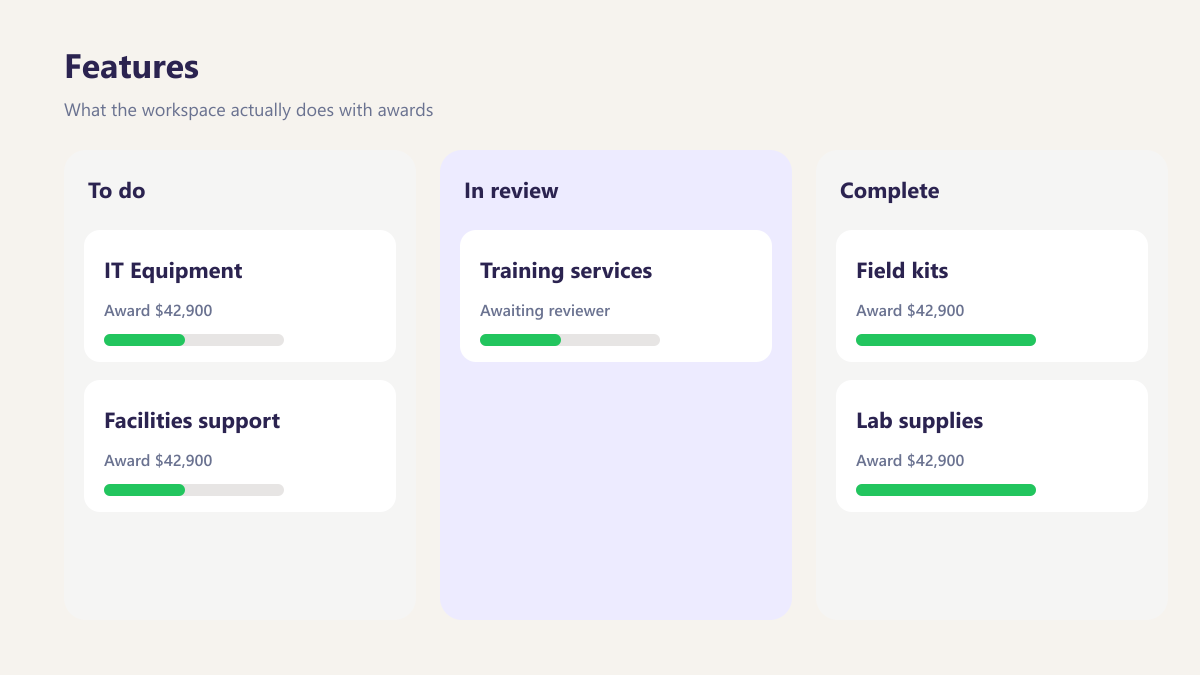
What the workspace actually does with awards, modifications and approvals.
- Features
- Your sector or role
- Glossary
FASTER THAN A QUESTION3 ROUTES
01 · FEATURES
See what the workspace does
Awards
Modifications
Approvals
02 · YOUR SECTOR OR ROLE
See it from where you sit
Government contractors
Buyers
Finance
Compliance
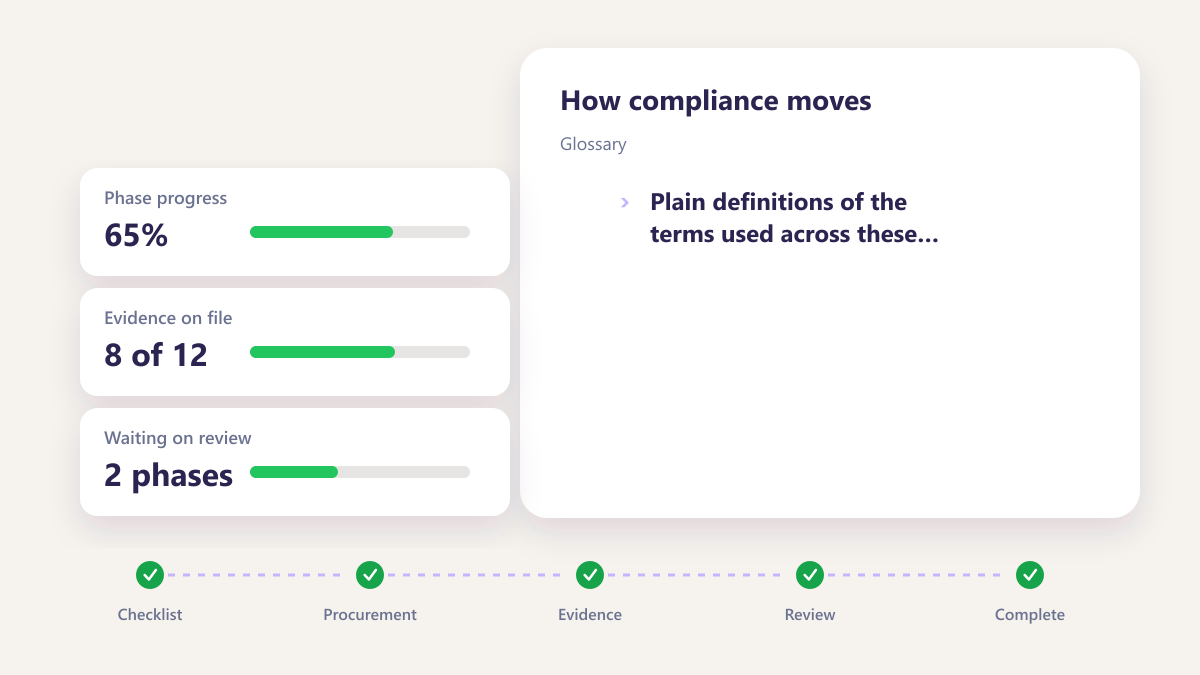
03 · GLOSSARY
Decode the term first
CPSR
Contractor purchasing system review
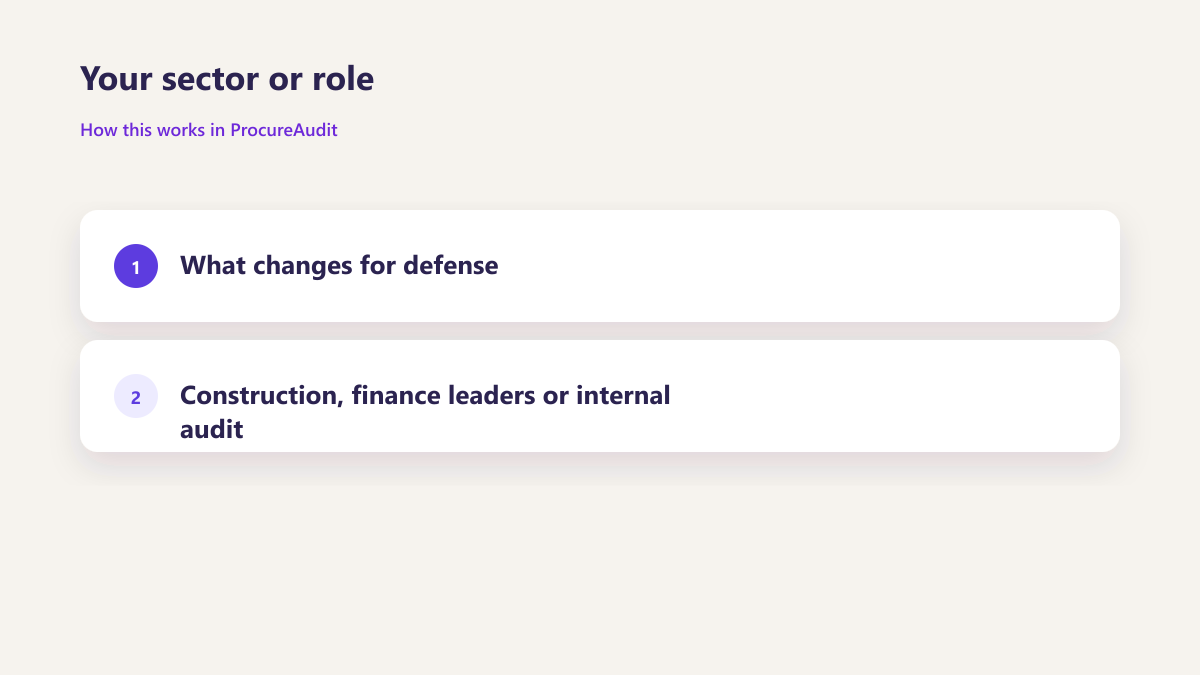
Your sector or role
What changes for defense, construction, finance leaders or internal audit.
Learn more